
Testing the Waters: a Texas ChE Field Trip
One man’s waste is another man’s fuel, and in the case of fourth-year Process Design and Operations students – affordable fuels are something they had to smell to believe.

Each semester, David Dalle Molle, associate professor of practice, challenges his fourth-year CHE473K Process Design and Operations students, colloquially known as “plant” students, with a unique process design problem statement. This spring, the student’s challenge was to design and evaluate (for technical feasibility, process safety risks, and economic profitability) a process to convert dairy manure to Renewable Natural Gas (RNG).
To expose his students to a similar process, professor Dalle Molle took his class on a field trip to the City of Austin’s Hornsby Bend Wastewater Treatment Plant. This practicum experience allowed the students to see a similar facility in operation but with a uniquely human feedstock that the city is flush with.
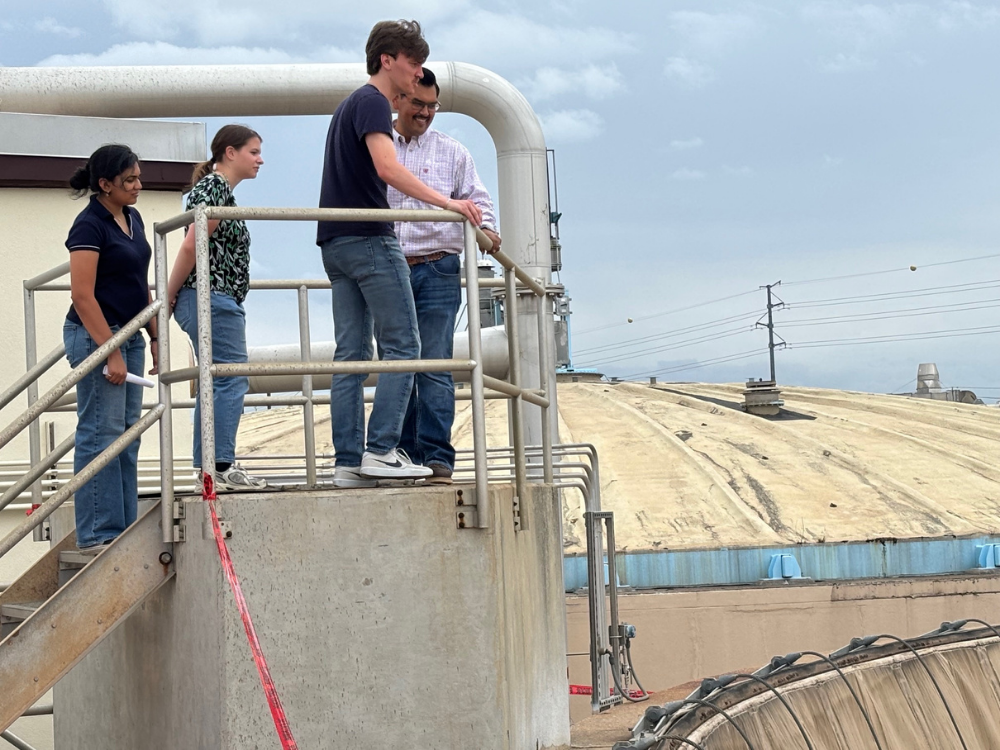
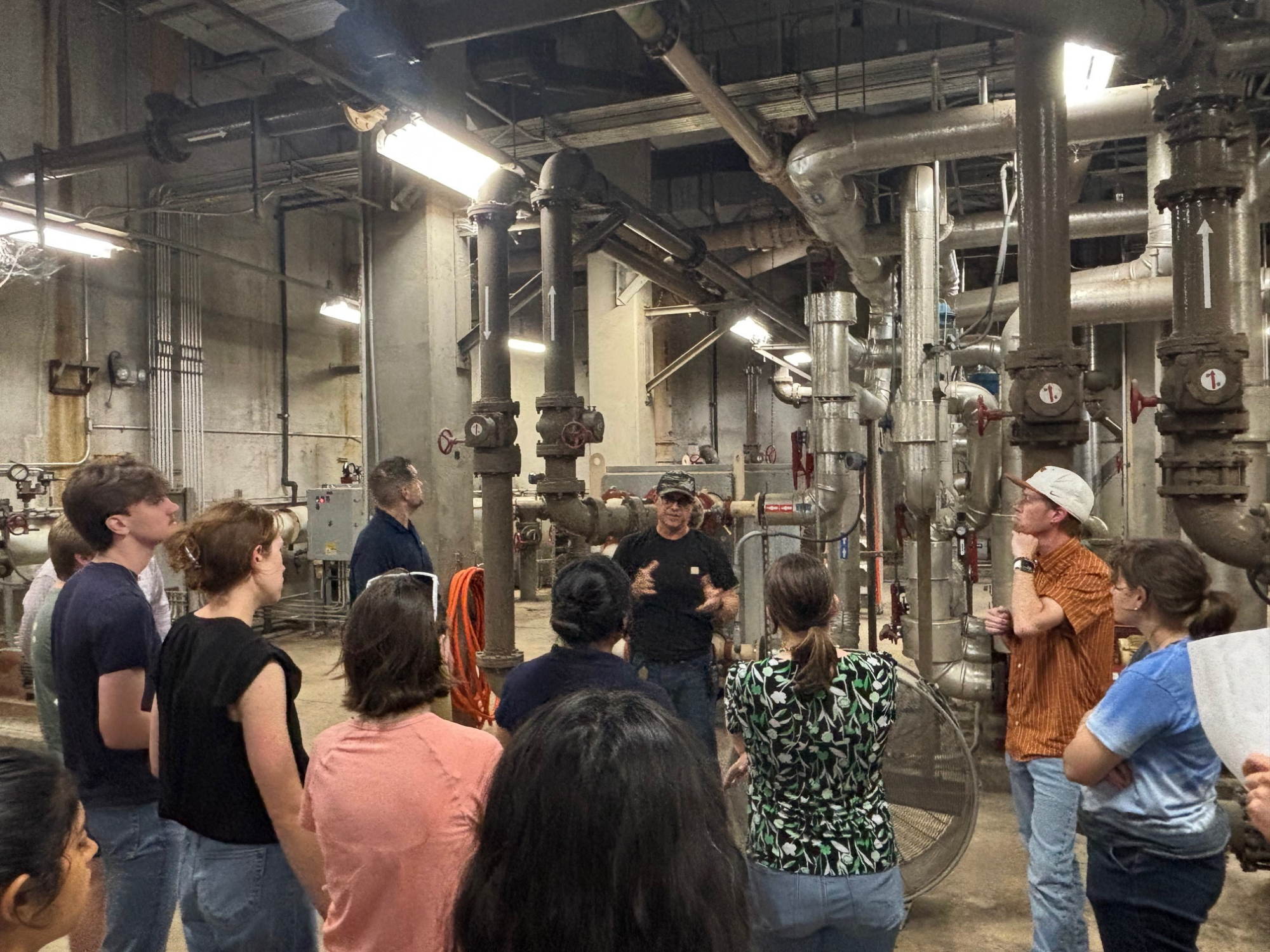
(L-R): Students peer over AD reactor at Hornsby Bend Wastewater Treatment Plant, Pump room and heating loop
Just east of downtown Austin, the site is home to a dense thicket of oaks, brush and briars, and the animals and waterfowl who call that area home. It also houses the award-winning sewage sludge recycling plant.
Visiting a wastewater treatment facility may not be most students’ choice for a field trip, but to budding chemical engineers it presents a unique opportunity to visit the facility’s Anaerobic Digester (AD)–a unit operation that is the heart of their design project. In addition to the ADs, the process has multiple centrifugal pumps, boilers, and counter current heat exchanges – all unit operations addressed in 473K’s prerequisites.
The Colorado River’s bend forms the western and southern boundaries of the 1,200-acre Hornsby Bend facility. The plant recycles all of the sewage sludge produced by Austin. Every day, 1.5 million gallons of sludge — the solid material removed from treated wastewater — is piped to Hornsby Bend from the city’s two major wastewater treatment plants.
Camille WheelerTexas Park’s & Wildlife Magazine
Hornsby Bend is most famous for its two man-made features: the Dillo Dirt compost produced on-site which combines human waste and yard trimmings to create an EPA-certified soil conditioner and the pond system which the city constructed in the mid 1950s.
While in the student’s project the feedstock was dairy manure, and not human, the product was also biogas which the students upgraded to Renewable Natural Gas. Their tour was comprehensive and included the feed preparation and filtering areas, dewatering operations, the boiler and pump houses, the AD reactors, and the digestate solids recovery operations (a key ingredient in Dillo Dirt).
In the end, the students took away several key learnings including 1) ADs operate better at constant hydraulic retention times, 2) temperature control is key to maximize biogas generation, and 3) you cannot believe the stuff that people flush down their toilet that has to be filtered out – up to ten tons per day of miscellaneous, non-human waste junk.