Wennie Wang Receives NSF CAREER Award to Advance Energy-Efficient Computing
Wang’s research could help in developing materials for in-memory computing, where information can be stored and processed closer together, potentially reducing the energy required to move data.
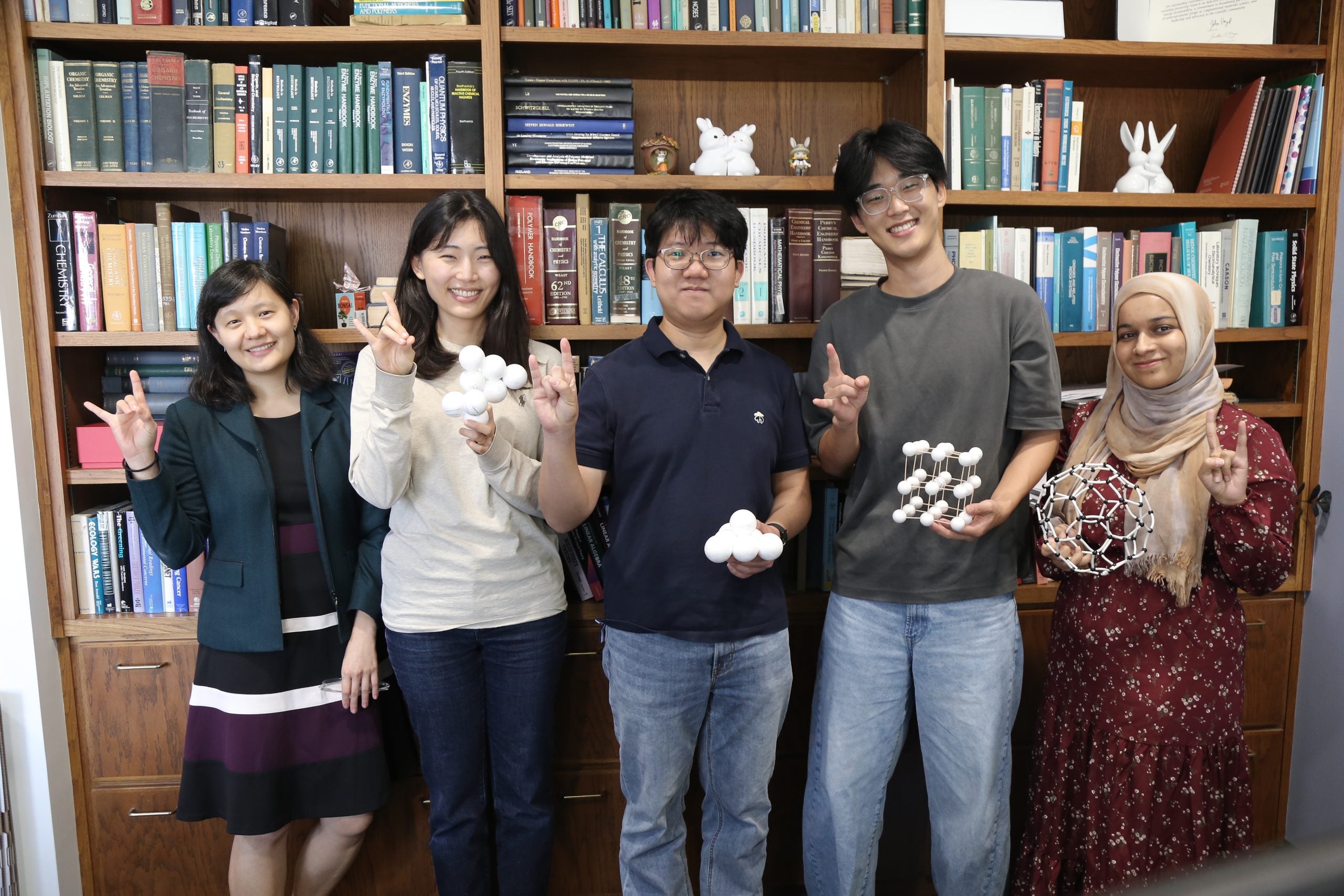
L-R: Asst. Professor Wennie Wang, Youngju Son, Suk Gyu Lim, Brian Lee and Zarin Tasnim. Jing Lian Ng not pictured.
Wennie Wang, assistant professor in the McKetta Department of Chemical Engineering at The University of Texas at Austin, has received the National Science Foundation (NSF) CAREER award to investigate how atomically thin materials can be used for next-generation memory and computing technologies. The Wang Materials Group focuses on understanding resistive switching, which refers to the ability to change between different electrical resistance states, and the role that atomic-scale defects and interfaces play in this process.
While the research takes place at a scale far smaller than anything we encounter in everyday life, its potential impact is much broader. Every text message, video stream, internet search and artificial intelligence application relies on electronic devices that store and process information. As computing becomes increasingly data-intensive, moving information between memory and processors requires significant amounts of energy. Wang’s research could help in developing materials for in-memory computing, where information can be stored and processed closer together, potentially reducing the energy required to move data.
Ultimately, the project aims to connect fundamental chemistry and materials science with the future of computing and to integrate these efforts into curriculum centered around computational literacy and materials science. A better understanding of how to atomically control electrical switching could help guide the development of smaller, more energy efficient memory technologies for the increasingly data driven world.
Wennie Wang received her B.S. Materials Science and Engineering from MIT in 2013, and her Ph.D. in Computational Materials from the University of California, Santa Barbara. She joined the department in 2022. In 2026, Wang was recognized as an emerging investigator by the Journal of Materials Chemistry C and in 2025 she received the Maria Goeppert Mayer Award from the American Physical Society (APS), which recognizes early-career women in physics.