Nicholas Peppas to receive 2026 F.J. & Dorothy Van Antwerpen Award for Service to the Institute
Known as a global pioneer in biomaterials, bionanotechnology, and polymer physics…
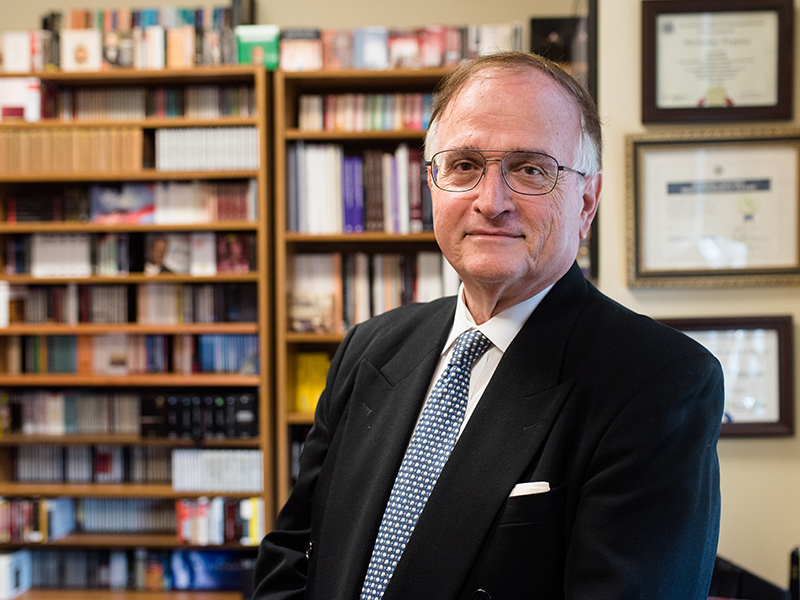
Professor Nicholas Peppas will receive the 2026 F.J. & Dorothy Van Antwerpen Award for Service to the Institute from the American Institute of Chemical Engineers (AIChE) during AIChE’s 2026 Honors Ceremony in Minneapolis, MN this November.
The Institute and Board of Directors’ Awards are AIChE’s highest annual honor. Sponsored by the Dow Chemical Company this award recognizes outstanding contributions and service to AIChE and the chemical engineering profession across professional and technical areas. Previous department recipients have been John J. McKetta in 1985, and Professor Emeritus Thomas Edgar in 2010.
Nicholas A. Peppas is a global pioneer in biomaterials, bionanotechnology, and polymer physics. He currently serves as the Cockrell Family Regents Chair in Engineering at The University of Texas at Austin, where he leads the Institute for Biomaterials, Drug Delivery, and Regenerative Medicine. Over a career spanning more than 55 years, his foundational discoveries have fundamentally changed how complex diseases like diabetes, cancer, and autoimmune conditions are treated.
Born in Athens, Greece, he earned his Diploma in Chemical Engineering from the National Technical University of Athens in 1971. He moved to the United States and completed his Doctor of Science (Sc.D.) in Chemical Engineering from the Massachusetts Institute of Technology (MIT) in 1973.
Before joining UT Austin in 2003, he spent 26 years as a professor of chemical engineering at Purdue University, where he helped establish their Department of Biomedical Engineering.
Peppas pioneered the use of hydrogels (swollen polymer networks) as biocompatible materials. He was among the first to develop pH- and temperature-sensitive “smart” hydrogels that release medication dynamically based on the body’s physiological changes. He formulated the exact mathematical equations and transport models that govern how drugs diffuse through polymers. These formulas serve as the global industry standard for designing controlled-release medications. His lab spearheaded breakthroughs in overcoming the digestive system’s barriers, leading to the development of oral delivery systems for high-molecular-weight proteins like insulin, aiming to eliminate the need for daily injections.
His research has directly contributed to more than 20 cleared medical products with multi-million dollar market values. He holds over sixty issued or pending patents and has co-founded three biotechnology companies.