
JOHN HARGIS* (B.S. 1959)
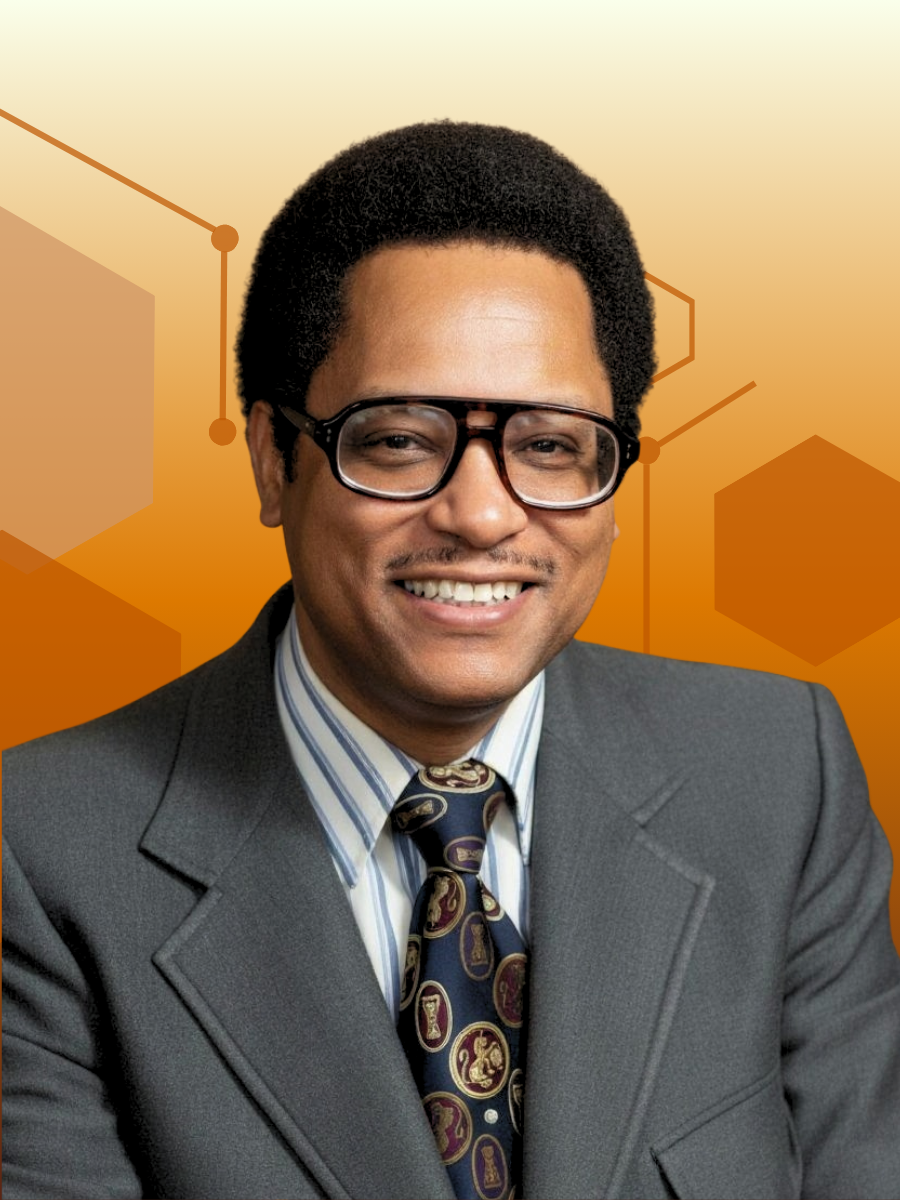 John Hargis was among the first seven African American undergraduate students, known as the Precursors, admitted to The University of Texas at Austin in 1954. His admittance to UT was drawn out over several years and marred by national court battles and fierce opposition from Texas legislators and UT’s then dean of admissions. John would eventually become UT's first Black undergraduate student in 1956, and the first Black student to receive an engineering degree in chemical engineering in 1959.
An Austin native, John graduated valedictorian of the then segregated Anderson High School in 1953. Once at UT, he leveraged religion as a common ground to connect with his peers and eventually served as vice president of the newly formed University Religious Foundation. He established the Epsilon Iota Chapter of Alpha Phi Alpha, the first intercollegiate fraternity for African American men, though it wasn’t officially recognized until after his graduation.
Post UT, John worked as a chemical engineer for Reichhold Chemicals, now Polynt Group, where he developed a chemical manufacturing facility that remained in use for a quarter century. In 1961, while at Ampex Corporation he received his first patent for polyolefin-coated magnetic recording tape. Audio Devices, Inc., which would become Capitol Records, lured him to Connecticut where he won the company’s President’s Award and was promoted to plant manager. He would go on to earn his MBA at the University of Bridgeport. In 1973, he was named vice president of manufacturing at Capitol Records, Inc. where his operations generated more than $30M in annual revenue.
Health concerns brought him back to Texas and UT. The first chairman of the Texas Exes’ Black Alumni Task Force in 1985, now known as Black Alumni Network, he set out to heal the wounds of the university experience for Black alumni and to increase Black participation in the alumni network. In 1986, he was appointed special assistant to the president for minority affairs at UT. After his death, the University named the undergraduate admissions building in his honor, and the College of Engineering established the John W. Hargis Endowed Presidential Scholarship and John W. Hargis Memorial Scholarship.
JOHN HARTMAN (B.S. 1964)

John Hartman is a retired entrepreneur, active civic volunteer and proud grandfather.
After graduating from The University of Texas at Austin in 1964, John earned an M.S. in chemical engineering from MIT in 1965, and an MBA from Harvard in 1967. He worked for 20 years for Exxon Chemical Company, now ExxonMobil, in Baytown, New York and Houston in various technical, marketing and management positions. He left in 1986 and with a partner bought the Lubrication Systems Company (LSC) of Texas, which they owned and grew for 21 years. LSC, along with two affiliated companies they started, developed specialized systems for lubricating rotating equipment which they supplied primarily to refiners and chemical companies globally. After selling these businesses, John founded a small business that helps churches and other non-profits install and finance rooftop solar systems.
Since retirement, John has served on the board of the Austin Presbyterian Theological Seminary, chaired the board of the Brazos Presbyterian Homes Holding Company and served as a consultant to small business owners in South Asia as part of a Christian private investment fund. He currently serves on the Session at the St. Philip Presbyterian Church and is president of the board of the St. Philip Day School, an early childhood education center providing tuition-free care and education to young children of qualifying low-income families.
He has been married for 60 years to Judye, also a 1964 graduate of UT Austin. They have two married sons and two teenage grandchildren. John and his wife now spend their summers at the Chautauqua Institution in western New York state where he enjoys lifelong learning and golf.
MARK MURRAY (B.S. 1992)
 Mark Murray is senior vice president of the acetyl chain at Celanese Corporation, with global responsibility for manufacturing, supply chain, commercial strategy, and financial performance across one of the company’s core value chains.
Since joining Celanese, Mark has held positions of increasing responsibility across commercial, strategic and operational functions. His work has strengthened the resilience and long-term competitiveness of Celanese’s acetyl businesses amid volatile feedstock conditions, evolving trade dynamics, and rising sustainability expectations. He is based in Dallas, Texas, after having led international teams out of Amsterdam, Frankfurt and Maastricht.
Mark earned a Bachelor of Science in chemical engineering from The University of Texas at Austin in 1992, where he was also a member of the Texas Cowboys service organization. He holds an MBA from Northwestern University’s Kellogg School of Management and a Master’s of Engineering Management from Northwestern's McCormic School of Engineering. Prior to joining Celanese, he spent four years with McKinsey & Company in the firm’s Dallas office.
Mark has served on the department’s External Advisory Council and is active in philanthropic efforts supporting education, STEM advancement and community development through the Celanese Foundation. He and his wife, Sarah, have been married for 27 years and have three daughters—Kate, Brooke and Sidney. He remains deeply engaged with his family, church, community and The University of Texas at Austin.
SHRAVANTHI REDDY (Ph.D. 2006)
 Shravanthi Reddy is co-founder and CEO of Vision Innovation Institute whose mission is to cure treatable blindness globally by 2050. She earned a Ph.D. in chemical engineering at The University of Texas at Austin in 2006. Prior, she earned a BSE in chemical engineering from Princeton University, where she also earned a varsity letter in tennis. She did postdoctoral research in materials science at the Max Planck Institute for Intelligent Systems in Stuttgart, Germany, as an Alexander von Humboldt Fellow, and went on to work as a fellow of the American Association for the Advancement of Science in Washington D.C.
As an executive of multiple startup medical technology companies, she oversaw development and FDA approval for a first-in-class dry eye treatment, development of biomimetic “sharkskin” devices for infection prevention, and manufacturing of novel intraocular lenses, with each company leading to acquisition by private equity or pharmaceutical companies. She has since co-founded and served as CEO and a board member for companies developing novel ophthalmic devices and pharmaceuticals.
Shravanthi enjoys volunteering with Ophthalmic World Leaders and the Cockrell School’s Engineering Advisory Board where she mentors students. She has served as a reviewer for the National Institute of Health and previously served on the McKetta Department of Chemical Engineering's External Advisory Council. She has supported students in her community by bringing enrichment classes, including music, sports, robotics and more, to the local elementary school.
WILLIAM "BILL" ZELLE (B.S. 1962)
 Bill Zelle retired as managing director of the Engineering and Construction Risk Institute (ECRI), a working group within the World Economic Forum’s engineering and construction community. Prior to that he was vice president of project management for Fluor Corporation’s petroleum and petrochemical division.
After obtaining his bachelor's degree, Bill began his career as a process engineer with Standard Oil of California, now Chevron, and subsequently Fluor Corporation. While at Fluor he received a Master of Science in finance as an Edward W. Carter Fellow at the UCLA Graduate School of Business Administration, now the Anderson School. His Fluor career was in project management of worldwide engineering, and construction of major process facilities, then as executive manager. He authored Fluor’s project execution plan, the required methodology for all Fluor projects. Subsequently he co-authored Fluor’s Business Risk Management Framework (BRMFSM) establishing the company's approach to project risk.
After Bill completed work on the BRMF, the World Economic Forum’s E&C subgroup recruited him as a founder and first managing director of ECRI, a non-profit platform where industry leaders, risk professionals and stakeholders exchange knowledge and develop better approaches to project risk management.
Bill and his wife Carol, also a UT Austin graduate, established The William and Carol Zelle Endowed Scholarship in the McKetta Department of Chemical Engineering. They are also members of the Texas Leadership Society.
Bill, having graduated before undergraduates had access to a computer of any sort, is a slide rule engineer. He points out that John McKetta threw chalk near, but never at him.
* Indicates posthumous honoree.


